Arroz con Pollo Carbs and Calories: Is Chicken and Rice OK for Diabetics?
Arroz con pollo, chicken and rice, is on the table across Latin America and in Latino homes all over the US: yellow, green, with peas, with beer, grandma's version. It is Sunday food and weeknight food. So if you have diabetes, high blood pressure or high cholesterol, the question isn't whether you can eat it, but how much and how to serve it.
Here are the approximate numbers for a plate, where they come from, and five simple changes to keep enjoying it.
Calories and carbs in a plate of arroz con pollo
Every recipe is different (more or less oil, more or less chicken, skin on or off), so these are approximate values for homemade arroz con pollo:
| Portion | Calories | Carbs | Sodium |
|---|---|---|---|
| 1 cup (≈ 200 g) | 300–350 | 35–40 g | 500–800 mg |
| Typical plate, 2 cups | 600–700 | 70–80 g | 1,000–1,600 mg |
| Large plate, 3 cups | 900–1,050 | 105–120 g | 1,500–2,400 mg |
For context:
- Carbs: a common reference for adults with diabetes is 45 to 60 g per meal. A typical 2-cup plate already goes over it.
- Sodium: the usual daily limit is 2,300 mg. A large plate can use up almost all of it.
- Calories: on a 2,000-calorie day, a typical plate is a third of the day.
Where the numbers come from
- The rice brings almost all the carbs: about 28 g per 100 g of cooked rice. The chicken adds almost none.
- Oil or annatto oil adds calories fast: about 120 per tablespoon.
- Chicken skin holds much of the saturated fat and cholesterol.
- Bouillon cubes and seasoning packets are the main source of sodium. A single cube can have close to 1,000 mg.
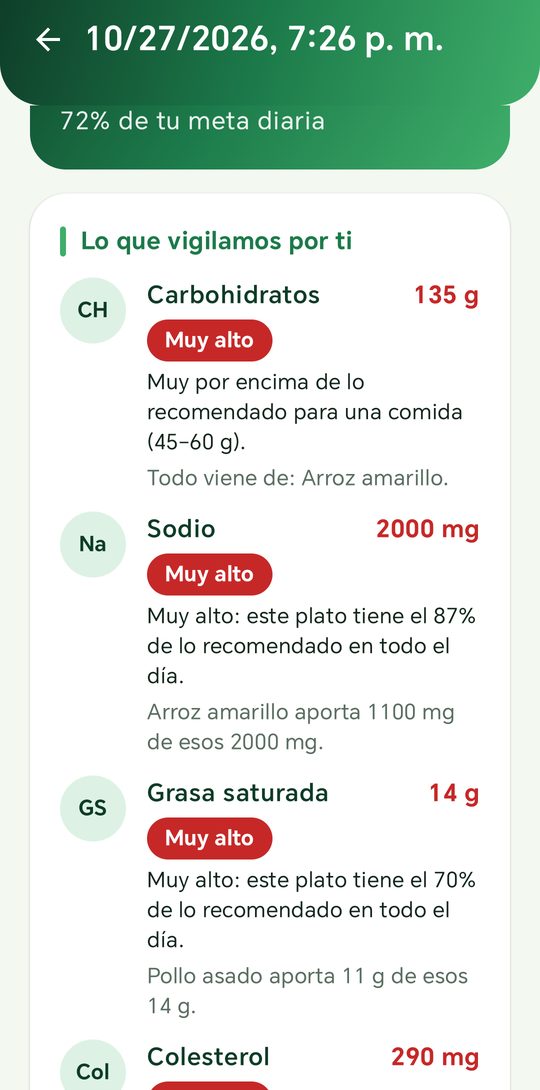
This is how Balancia shows a large plate of roast chicken with yellow rice (app shown in Spanish):
5 choices on your plate to keep eating arroz con pollo
You don't need to change the family recipe. What helps most is what you serve yourself and how you eat it:
- Serve yourself one cup, not two. The choice that helps most: it cuts the carbs in half.
- Fill the rest of the plate with salad or vegetables. They fill you up and add almost no carbs.
- Leave the chicken skin aside. That's where much of the saturated fat is.
- Don't add salt at the table. Arroz con pollo already has plenty of sodium; a squeeze of lime adds flavor without adding any.
- Drink water with it, not juice or soda. A glass of juice adds about 25 g more carbs.
What about brown rice?
Brown rice has more fiber, which helps blood sugar rise more slowly, but its carbs per cup are similar to white rice. Switching helps, but it doesn't replace watching the portion.
Related guides
- Foods that raise cholesterol: 10 foods high in saturated fat
- High-sodium foods to watch with high blood pressure
- How to calculate carbs in a meal: by hand, with the plate method or from a photo.
Balancia shows the carbs, sodium and fat on your plate, which food they come from and how to balance it. It works in English and Spanish, understands Latin home cooking, and your history stays on your phone.
See Balancia on Google Play
Frequently asked questions
How many calories are in a plate of arroz con pollo? It depends on the portion and the oil. One cup has about 300 to 350 calories; a typical 2-cup plate, about 600 to 700.
How many carbs are in arroz con pollo? About 35 to 40 grams per cup. A 2-cup plate has about 70 to 80 grams.
Is chicken and rice good for diabetics? It can fit, if you watch the portion: one cup with a big serving of salad or vegetables usually stays within one meal's reference. Your doctor or dietitian sets the right amount for you.
Is arroz con pollo high in sodium? It can be. Bouillon cubes and seasoning packets easily take a plate to 1,000 mg or more.
For information only. Values are approximate and do not replace advice from your doctor or dietitian. Balancia gives approximate estimates and does not diagnose or treat any disease.